
I know that, in my recent posts, I may have portrayed competition as somewhat of a challenge to be overcome. The reason I’ve done that is that I want you to:
- Know in detail what the other people providing similar services in your field are doing well, doing poorly, or not doing at all (that YOU could do), so that…
- You can intelligently position yourself as a logical option for your Ideal Clients in such a way that there’s very little competition for what you do, meaning that…
- You stand a much better chance of getting more of the kind of work that you really want.
But today I want to take a step back and reframe the way you look at your competitors.
Competition vs Collaboration
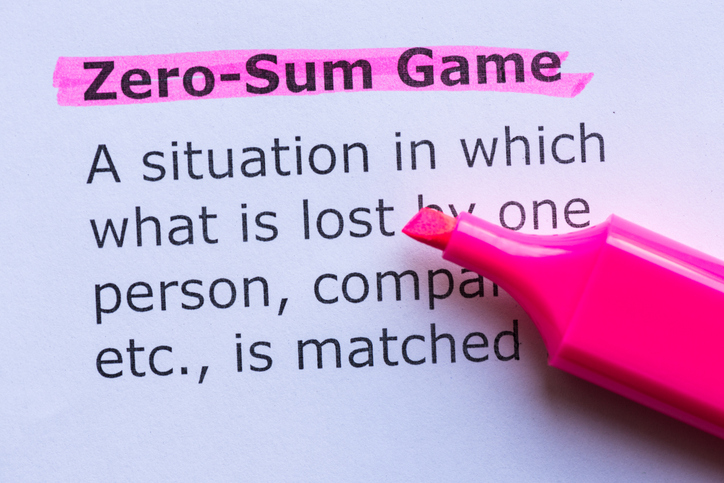
The truth of the matter is that it’s not a zero sum game.
Your competitors don’t have to do poorly in order for you to do well–or vice versa.
Forget all that cut-throat crap. That’s not what this series of blog posts about competitors is all about.
Let me put it this way…
How many school districts are there in the U.S.? A quick Google search tells me there are 13,300. That’s a LOT of potential clients you could work for.
And, of course, many times you’ll be hired by an individual school, not a whole district.
So, how many individual schools are there in the U.S.? Google says…
130,930, using the most recent data available. So, about 10X more individual schools than school districts.
And how many of those schools do you need to be working for at any one time in order to make a good living…or even a dream living? Three? Four? Five?
I don’t know your income goals or the amount of time you have available to do your consulting work, but I’m guessing the answer to my question is in the single digits.
So, there’s no shortage of clients. In fact, the market is HUGE.
And you only need the tiniest piece of the market to be very successful.
So, it’s NOT about beating your competitors.
It’s really just about intelligently positioning yourself to be the only one who does exactly what you do in the exact way you do it (to be a “category of one”) so that you don’t have to fight for the scraps because you’re doing the same exact thing as 100 other consultants.
And if you follow my advice in my upcoming posts over the next month or so, I’ll show you exactly how to do this positioning using the data you’ve already gathered in your competitor database.
SO…
- Now that you see that there’s plenty of work for everyone in your field
- And now that you see that you can set yourself up in such a way that you aren’t actually competing with any of the other service providers in your field anyway…
That opens up a whole new world of possibilities for your business, based on one key mindset shift…
It’s much more profitable (and enjoyable) to view your competitors as possible collaborators.
Let me give you a few examples of what that might look like.
- I know a consultant who has created an informal little “network” of consultants in his field who present on similar topics. When a school or district contacts one of them to do some work, but for one reason or another the timing doesn’t work out, they simply recommend someone else from the network for the gig. Everyone in the group has received work “out of the blue” just because they decided to help each other.
- This kind of arrangement can also be formalized by joining with several others in your field who do similar (but not exactly the same) presentations and consulting and forming a collaborative business entity. This allows you to pool your resources and steer job inquiries to the person in the group best suited for that specific gig. (But I would also caution you that getting into a formal business arrangement such as this can have its headaches, so I would only recommend that you do this with people you consider friends.)
- Or, you could recommend a near-competitor as a natural follow-up to you when you’ve finished your work with a school or district–and they can recommend you in a similar situation. This makes it easier on the school administrator, who doesn’t have to start from scratch to find their next PD provider. And it brings new work in for the consultant without them having to do anything.
- You could even band together with others in your field to create a virtual summit or even a live event that spans key topics in your field.
That’s just a taste of the possibilities…and every one of these is actually being done by educational consultants out there in the “real world” as we speak.
Once you make the mindset shift from “I have to compete with these people” to “how could I collaborate with these people, to our mutual benefit?” the possibilities are unlimited.
So, here’s today’s action step. Take some time to really think this through.
Open up the competitor database you’ve created and start going through the data you’ve collected, but this time, from the mindset of, “What possibilities for collaboration exist here?”
Jot down ideas as they come to you. You could even add another column to your database for “Collaboration Possibilities,” if you like.
And then, don’t stop there. If a particular possibility jumps out at you as something you’d love to do, go ahead and reach out with an email, DM, or phone call to that competitor/possible collaborator and explore the possibility.
In a few weeks, your whole business model could be changing–in a very positive direction–just by making a mindset shift where you start thinking of cometitors as potential collaborators.
OK, that wraps up my series of posts about competitor research.
There’s only one aspect of positioning left to explore, but it’s the BIG one: offers.
Now that you’ve…
- Created a Persuasive Persona to attract your Ideal Clients
- Created one or more detailed Ideal Client Personas to target with your marketing
- And analyzed the top competitors (aka collaborators) in your field…
It’s time to put that all together. And it’s at the intersection of those three elements of positioning that you’ll find exactly what you need to offer to your Clients that they can’t wait to buy.
And we’ll get into that starting with my next post. Stay tuned!
To Your Success,
Willy
P.S.–I hope that you can see the value that doing a deep competitor analysis can provide for your consulting business.
That said, I also realize that the steps I’ve laid out over the past week can be somewhat labor intensive.
If you’d love to have this kind of competitor analysis at your fingertips to use in strategizing the best course for your business, but you don’t want to do all the work yourself (or simply don’t have the time), we can do it for you.
Our Competitor Deep Dive service will take your business and follow all the steps laid out in this blog post series (and more!) to create a Competitor Research database for you, as well as an in-depth report with suggestions for positioning yourself to lead your market.
If that sounds like something you could use, just hit the link 🔽. We’d love to chat.